 October 16, 2026
Have you been experiencing persistent tingling in your hands, numbness in your feet or unexplained muscle weakness? If these symptoms keep returning, your doctor may recommend tests to understand how well your nerves and muscles are functioning.
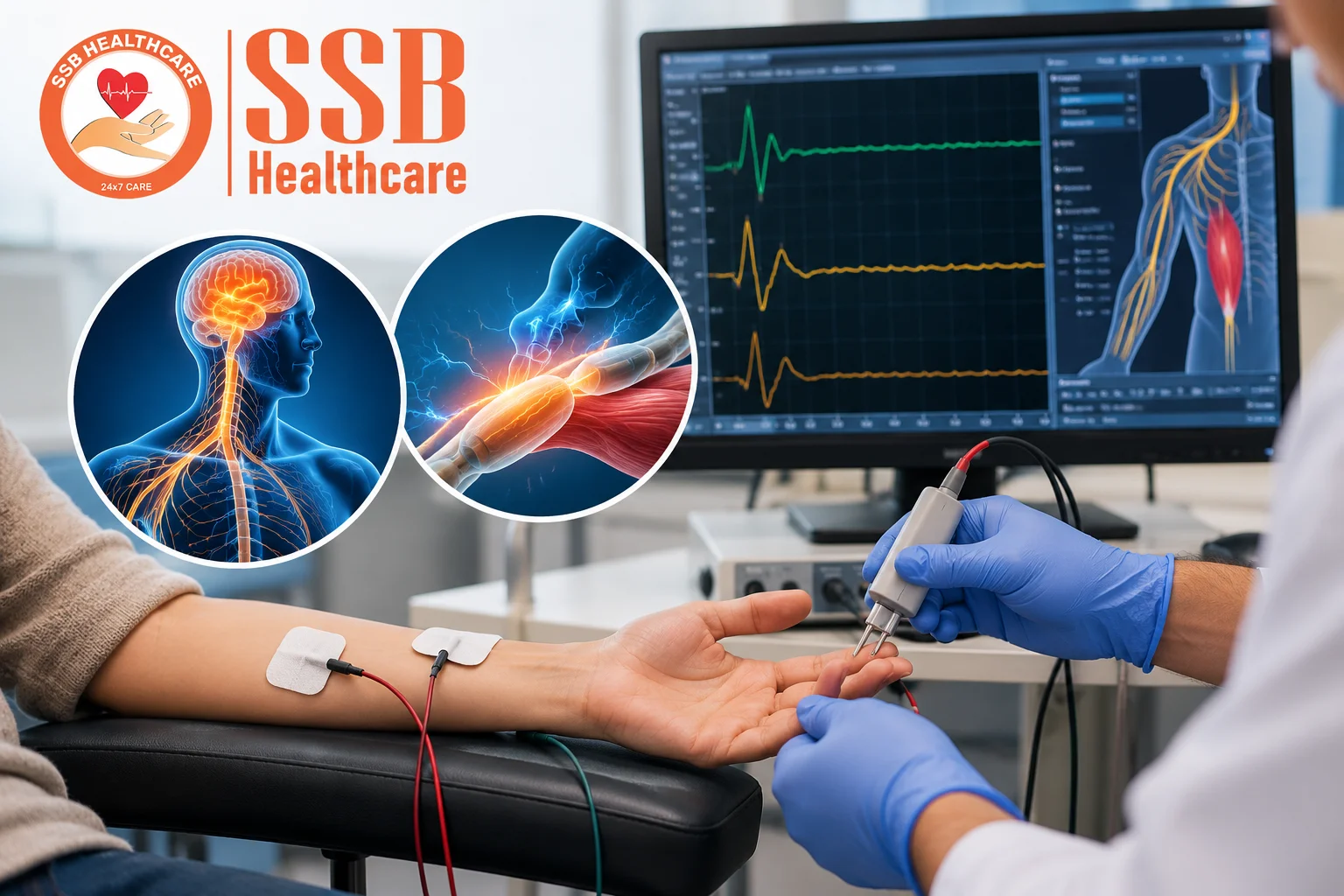
Two commonly used investigations are electromyography (EMG) and a nerve conduction study (NCS), also known as a nerve conduction velocity (NCV) test.
Although these tests are often performed during the same appointment, they measure different aspects of nerve and muscle function.
A nerve conduction study evaluates how electrical signals travel through peripheral nerves, while needle EMG measures electrical activity within muscles. Together, they can help doctors identify certain nerve injuries, muscle disorders and problems affecting communication between nerves and muscles.
Understanding what happens during these tests can make the diagnostic process easier to follow.
Electromyography, or EMG, is a diagnostic test that records electrical activity produced by muscles.
Muscles respond to signals sent through motor nerves. When a muscle contracts, its electrical activity changes in ways that can be measured.
During needle EMG, a trained physician inserts a very thin recording electrode into selected muscles. The equipment records electrical activity while the muscle is relaxed and while the patient gently contracts it.
The findings may help identify whether muscle weakness is associated with a disorder affecting the muscle itself or its nerve supply.
A neurologist may consider EMG when a patient experiences:
EMG is not necessary for every episode of muscle pain or twitching. Its usefulness depends on the patient's medical history and examination findings.
A nerve conduction study measures how effectively electrical signals travel along selected peripheral nerves.
Peripheral nerves carry information between the brain, spinal cord and different parts of the body.
During the test, electrodes are placed on the skin over the nerves being examined. A brief electrical stimulus is delivered, and the resulting nerve or muscle response is recorded.
The test measures characteristics such as response size and the time taken for signals to travel.
These findings help doctors assess whether a nerve is functioning normally or shows evidence of damage.
NCS may be useful when symptoms suggest conditions such as:
For example, someone experiencing repeated tingling in the thumb, index finger and middle finger may be evaluated for carpal tunnel syndrome.
A nerve conduction study can help assess whether the median nerve is affected at the wrist.
However, the diagnosis must also consider the symptoms and clinical examination.
The main difference is what each test measures and how the recording is performed.
| Feature | EMG test | Nerve conduction study |
|---|---|---|
| Full name | Electromyography | Nerve conduction study |
| Main purpose | Measures electrical activity in muscles | Measures electrical responses conducted by peripheral nerves |
| Method | A thin needle electrode is inserted into selected muscles | Surface electrodes deliver and record brief electrical responses |
| Common symptoms investigated | Weakness, muscle wasting, suspected nerve-root or muscle disorders | Numbness, tingling, weakness and suspected nerve compression |
| Patient experience | Brief needle discomfort may occur | Short electrical pulses may feel like quick shocks or tingling |
| Used together? | Frequently | Frequently |
Neither test is automatically better than the other. They answer related but different clinical questions. A doctor may recommend one or both depending on the suspected condition.
EMG and nerve conduction studies are often performed together because they provide complementary information.
For example, a patient with persistent leg weakness may have symptoms caused by a peripheral nerve disorder, nerve-root compression or a muscle condition.
Nerve conduction testing helps evaluate the function of selected peripheral nerves.
Needle EMG provides additional information about how muscles behave electrically and whether findings suggest an issue with their nerve supply.
Together, the results may help a specialist determine the likely location and pattern of a disorder.
They can detect abnormalities associated with many peripheral nerve disorders, but they do not detect every type of nerve damage.
For example, routine nerve conduction studies primarily assess larger nerve fibres. Some conditions affecting small sensory nerve fibres may not appear on standard testing.
A normal result therefore does not exclude every neurological condition.
The doctor may recommend additional assessment when symptoms persist despite normal electrodiagnostic findings.
Doctors generally recommend electrodiagnostic testing when the findings could help clarify the diagnosis or guide treatment.
Repeated tingling in the hands or feet may suggest a peripheral nerve problem.
If symptoms continue, a neurologist may use nerve conduction testing to investigate conditions such as peripheral neuropathy or focal nerve compression.
Difficulty gripping objects, lifting the foot while walking or performing previously manageable movements may suggest a problem affecting nerves or muscles.
Needle EMG can help investigate the possible source of weakness.
Pain radiating from the neck into an arm or from the lower back into a leg may indicate irritation or compression of a spinal nerve root.
In selected cases, EMG helps evaluate possible nerve-root involvement.
However, testing is not needed for every patient with back pain or sciatica.
Persistent twitching accompanied by progressive weakness or muscle wasting may require neurological assessment.
Electrodiagnostic testing can contribute to that investigation.
Important: Muscle twitching alone does not establish a serious neurological diagnosis. Many benign conditions can also cause twitching.
Knowing what to expect can help reduce uncertainty before your appointment.
The clinician may ask about the location and duration of symptoms, previous injuries and relevant medical conditions.
The exact muscles and nerves selected for testing depend on this assessment.
Small electrodes are placed on the skin.
The clinician delivers brief electrical pulses and records the responses.
You may experience a quick tingling or tapping sensation.
Several nerves may be examined depending on the suspected condition.
When required, a thin needle electrode is placed into selected muscles.
You may be asked to relax the muscle and then contract it gently.
The equipment records the resulting electrical activity.
Unlike therapeutic electrical stimulation, standard needle EMG records activity rather than delivering an electrical treatment into the muscle.
The clinician interprets the patterns recorded during testing.
The results are considered alongside the patient's symptoms, neurological examination and any other investigations.
Sometimes additional tests are needed before a definitive diagnosis can be established.
Both tests can cause temporary discomfort, but the experience varies.
During nerve conduction testing, electrical stimulation may feel like a quick snap, tingling sensation or brief shock.
During needle EMG, the insertion of the electrode may produce a short pinching sensation. Some muscles may feel sore during or shortly after examination.
Mild soreness or small bruises can occur after needle testing.
Most patients can return to normal activities afterwards, unless their clinician advises otherwise.
If discomfort becomes difficult to tolerate, tell the examiner. The clinician can explain what is happening and determine whether adjustments are possible.
Preparation is usually straightforward, but it is important to follow the instructions from the testing facility.
Choose loose clothing that allows access to the arms or legs being examined.
You may be asked to change into a medical gown.
Skin creams and oils can interfere with electrode contact.
Your testing provider may advise avoiding them on the day of your appointment.
Tell the testing team about prescription medication, particularly blood-thinning medicines.
Do not stop prescribed medication unless the relevant clinician specifically instructs you to do so.
Inform the team if you have a pacemaker, implanted defibrillator or another electronic medical device.
The clinician will determine whether special testing precautions are necessary.
Bleeding disorders, significant skin infections and certain medical conditions may affect how testing is performed.
Providing a complete medical history helps the examiner choose appropriate precautions.
The duration depends on how many nerves and muscles need to be examined.
A focused test may take around 20–30 minutes, while more extensive electrodiagnostic testing can take an hour or longer.
Some patients require only nerve conduction studies. Others need both NCS and needle EMG.
The examiner decides how much testing is necessary based on the symptoms and findings.
An abnormal result does not automatically indicate a permanent or severe neurological condition.
The significance depends on the pattern of abnormalities, the nerves or muscles involved and the clinical findings.
For example, nerve conduction studies may show changes compatible with carpal tunnel syndrome or certain peripheral neuropathies.
Needle EMG may demonstrate findings that support nerve-root injury or particular muscle disorders.
However, the tests do not always identify the exact underlying cause.
Further blood tests, imaging or specialist investigations may be recommended.
Results should therefore be interpreted by a qualified clinician rather than assessed from individual values without context.
Consider neurological evaluation if you experience persistent numbness, recurring tingling, unexplained weakness or progressive muscle wasting.
A neurologist can examine your symptoms and determine whether electrodiagnostic testing would provide useful information.
For patients seeking neurological care in Delhi, the Neurology department at SSB Healthcare provides information about assessment and relevant services.
Sudden weakness affecting one side of the body, facial drooping or difficulty speaking requires emergency medical attention rather than a routine EMG appointment. Rapidly progressive weakness, especially with breathing or swallowing difficulty, also requires urgent assessment.
No. Needle EMG records electrical activity within muscles, while a nerve conduction study measures how electrical signals travel through selected peripheral nerves. They are frequently performed together.
Yes. They can help identify many peripheral neuropathies involving larger nerve fibres. However, certain conditions, including some small-fibre neuropathies, may not appear on routine testing.
EMG cannot directly show a slipped disc. It may identify evidence of nerve-root dysfunction associated with certain spinal conditions. MRI may be considered when detailed imaging of spinal structures is needed.
They are generally safe when performed appropriately. Temporary discomfort, soreness or bruising may occur. Patients with implanted devices, bleeding disorders or relevant medication use should inform the testing team.
Most people can resume ordinary activities, including driving, after testing. Follow any individual instructions provided by your clinician, particularly if another procedure or medicine affects your ability to drive.
Not necessarily. Depending on the suspected cause, your clinician may recommend nerve conduction testing alone or combine it with needle EMG.
EMG and nerve conduction studies are useful investigations for understanding certain nerve and muscle problems, but they measure different things.
Nerve conduction studies assess how electrical signals travel through peripheral nerves, while needle EMG examines electrical activity within muscles.
These tests may help investigate persistent numbness, tingling, muscle weakness and selected nerve injuries. However, not every patient with these symptoms requires both investigations.
If your symptoms continue or interfere with everyday activities, a neurological evaluation can help determine which tests are appropriate.
For information about specialist assessment, explore SSB Healthcare's Neurology services in Delhi.
2026 © SSB Heart and Multispecialty Hospital.
 International
 Find a
 Lab
 Health
 Careers