 August 11, 2026
If you are searching for ECG and TMT, the useful first step is to define the exact problem, its urgency and the kind of expertise it needs. This guide is written for people comparing two commonly ordered heart tests.
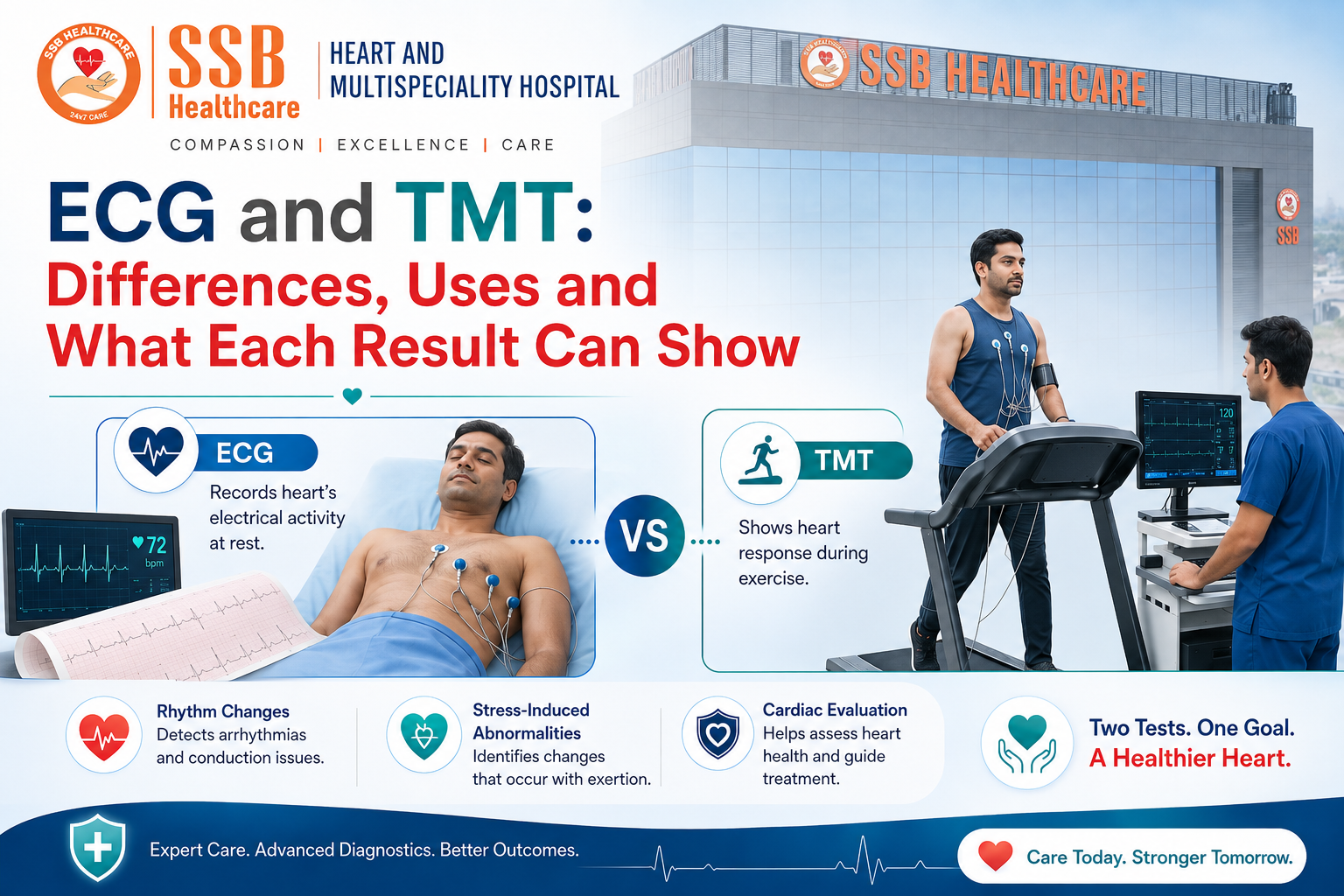
It will help you understand why a resting ECG and treadmill test answer different clinical questions. A treadmill test, often called TMT or exercise ECG, records the heart's electrical activity and checks blood pressure while a person exercises at gradually increasing intensity.
A resting ECG records the heart at rest, so the two tests answer related but different questions. Depending on your symptoms and medical history, a doctor from the Cardiology Department at SSB Healthcare may recommend one or both tests.
The aim is informed discussion, not self-diagnosis or a promise that one test or treatment suits everyone.
A resting ECG records a short sample of the heart's electrical activity while the patient lies still. TMT combines repeated ECG recording with staged exercise, blood pressure checks and symptom monitoring.
The two tests may be ordered together because the resting tracing provides a baseline and helps determine whether exercise changes can be interpreted.
| Situation | Suggested Action | Why It Matters |
|---|---|---|
| Resting ECG | Heart rhythm and electrical activity at rest | Usually takes only a few minutes and involves no exercise. |
| TMT or exercise ECG | Heart response during increasing physical work | Adds exercise capacity, symptoms and blood pressure response. |
| Stress echo | Heart function and movement during stress | Adds ultrasound images when more detail is needed. |
| Current severe chest symptoms | Not a routine testing situation | Urgent medical assessment comes first. |
A resting ECG can show heart rate, rhythm, conduction patterns and electrical clues linked with several heart conditions. It is quick, painless and does not require exercise.
Doctors may use an ECG while assessing symptoms such as:
If your main concern is an irregular heartbeat or a sensation of your heart racing or skipping beats, you can also read SSB Healthcare's guide to heart palpitations, their causes and warning signs.
A normal short recording can miss an intermittent rhythm problem. In that situation, a Holter monitor or longer event monitor may be more suitable than repeatedly performing the same brief ECG.
A TMT or treadmill test observes how the heart and blood pressure respond as physical work increases. It also records exercise capacity and whether symptoms appear at a reproducible workload.
It may be considered for:
TMT is not appropriate for every patient, especially when urgent symptoms, inability to exercise or an uninterpretable resting ECG changes the testing strategy.
SSB Healthcare's cardiology services in Faridabad include ECG, TMT, Stress Echo, Holter monitoring and ECHO with Colour Doppler, allowing the treating cardiologist to select testing according to the clinical question.
A resting ECG needs little preparation beyond access to the chest for electrode placement.
TMT requires suitable footwear, exercise readiness and specific instructions about meals, caffeine, smoking and medicines.
Before a TMT:
Never stop a heart medicine simply to make the test more likely to show a problem. Follow the ordering clinician's instructions because the decision depends on the purpose of the study.
The ECG report focuses on the heart's electrical activity while you are resting.
A TMT report combines several pieces of information, which may include:
Neither report should be interpreted in isolation.
A cardiologist compares the findings with your symptoms, medical history, cardiovascular risk factors and examination before deciding whether reassurance, treatment or another investigation is appropriate.
Book the test that has been recommended after an appropriate clinical assessment.
If a referral says only “ECG/TMT” and the diagnostic centre is unsure, confirm whether the doctor requires both a resting ECG and an exercise test.
If you are unsure which cardiac test is appropriate for your symptoms, you can find a cardiologist at SSB Healthcare and discuss your symptoms before arranging diagnostic testing.
Current severe chest pain, fainting or significant breathlessness is not a routine test-booking question. Urgent assessment should come first, and the treating medical team can determine which investigations are safe and necessary.
SSB Healthcare also provides guidance on chest pain and when hospital assessment may be required.
Keep both reports when both studies are performed. The resting tracing, exercise stages, symptoms, heart rate, blood pressure and recovery findings belong to one clinical story.
Removing one page from that context can make later interpretation more difficult.
If cost or travel makes repeat visits difficult, ask the ordering clinician which test should happen first and how quickly the report requires review. Do not select a test only by price when one study cannot answer the intended clinical question.
A correctly selected investigation is more useful than collecting several reports without a clear medical plan.
Preparation improves the quality of the test and the clinical decision based on it.
Not necessarily. TMT answers specific clinical questions, and its usefulness depends on the individual, the reason for testing and whether an adequate level of exercise was achieved.
An abnormal result does not automatically prove that a coronary artery is blocked. Symptoms, ECG quality, exercise capacity, risk factors and other investigations may influence interpretation.
TMT is not a fitness challenge to be won.
The purpose is controlled cardiovascular monitoring. The medical team may stop the test because of symptoms, ECG findings, changes in blood pressure, fatigue or other clinical reasons.
A resting ECG represents only a short period of heart activity. An intermittent problem may not occur during that recording. Depending on the symptoms, a cardiologist may recommend longer monitoring such as a Holter test.
Take notes or bring a trusted person if the testing relates to a new diagnosis or an important treatment decision.
Useful questions include:
SSB Heart & Multispeciality Hospital, Faridabad provides cardiology services that include ECG, TMT, Stress Echo, Holter Monitoring and ECHO with Colour Doppler.
The hospital is located at Plot No. 69, Mathura Road, Near Neelam Flyover, Sector 20A, Faridabad, Haryana 121002.
Patients who want broader preventive evaluation can also explore the hospital's health check-up services and discuss with their doctor whether cardiovascular screening is appropriate for them.
Service availability, clinician schedules and individual suitability for a test should always be confirmed directly with the hospital.
Do not wait for a routine ECG or TMT appointment when symptoms suggest a potentially time-sensitive medical problem.
Seek urgent medical assessment for symptoms such as:
This list cannot cover every emergency.
Severe symptoms, rapid deterioration or a strong sense that something is seriously wrong should prompt urgent medical assessment.
Both tests record the heart's electrical activity through electrodes attached to the chest. A resting ECG records activity while you remain still, while TMT continues monitoring as exercise intensity gradually increases and during recovery.
A resting ECG provides a baseline and may identify patterns that affect how an exercise ECG should be interpreted. TMT then adds information about workload, symptoms, blood pressure and the heart's response to physical exertion.
A short resting ECG or scheduled TMT may miss an intermittent rhythm problem if it does not occur while the test is being performed. Depending on symptom frequency and triggers, a clinician may recommend Holter monitoring or another form of longer-duration rhythm monitoring.
Not automatically. An abnormal TMT finding needs to be interpreted alongside symptoms, cardiovascular risk factors, the resting ECG, exercise capacity and other clinical information. Your cardiologist may recommend additional testing where necessary.
Booking and insurance requirements may vary. Even when direct appointments are available, clinical assessment can help determine whether ECG, TMT, Holter monitoring, stress imaging or another investigation is the most appropriate first test.
Bring your current medication list, relevant prescriptions, previous ECGs or cardiac reports, laboratory results and information about important medical conditions. For TMT, wear comfortable clothing and suitable walking shoes.
Severe chest pain, collapse, significant breathing difficulty, new stroke-like symptoms or rapid deterioration should be assessed urgently rather than waiting for a routine cardiac test.
If you are looking for ECG and TMT testing in Faridabad, start by describing the symptom or clinical question you need help with when arranging an appointment.
Ask which test is appropriate, whether previous cardiac reports should be reviewed and whether you should first consult a cardiologist.
You can contact SSB Healthcare for appointments and current service information.
For a medical emergency, seek emergency medical care rather than waiting for an online enquiry or routine test appointment.
This article provides general health information and does not diagnose a condition or replace an in-person medical assessment. Test suitability, interpretation, treatment choices, risks and follow-up requirements differ between patients. A qualified healthcare professional should review individual symptoms and test results.
2026 © SSB Heart and Multispecialty Hospital.
 International
  Find a
  Lab
Lab  Health
  Careers