 October 4, 2026
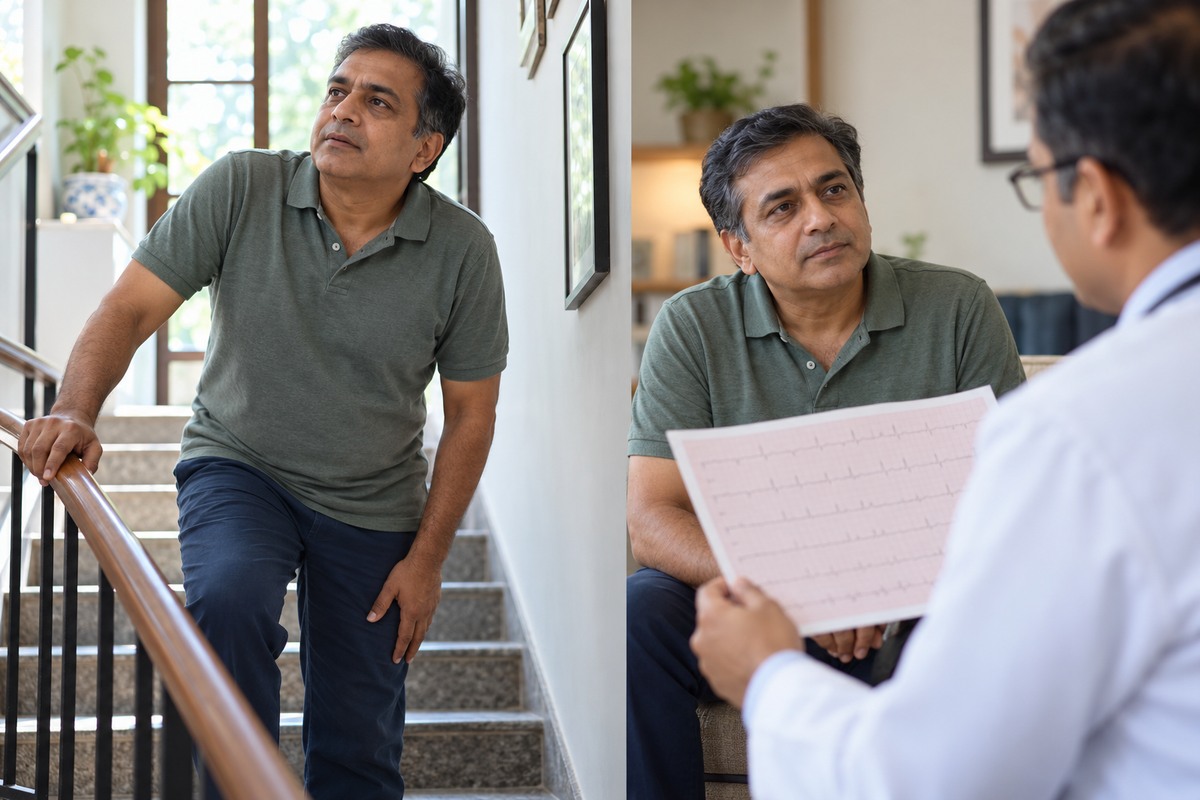
You used to climb two flights of stairs without thinking about it. Lately, you stop halfway. The ECG at a clinic was normal, so should you forget about it? Breathlessness with normal ECG in Delhi still deserves assessment when it is new, persistent or getting worse. An ECG is a brief record of the heart’s electrical activity. It does not by itself explain how well the heart pumps during daily activity, and it does not assess every lung, blood or fitness related cause.
The aim of a medical visit is to work out what changed, how urgent it is and which test, if any, would answer the next useful question. Do not assume breathlessness is “just age” or “just pollution,” especially if your usual capacity has fallen.
Think about what you could do three months ago and what you can do now. Can you walk the same distance? Do you pause while carrying groceries or speaking? Does the problem occur only on stairs, or also while sitting or lying down? Do you wake at night needing to sit up to breathe?
Note other symptoms: chest pressure, a fast or irregular pulse, swelling in the legs, cough, wheeze, fever, fatigue, dizziness or fainting. Tell the clinician whether the change began suddenly or gradually. Bring a medicine list and mention smoking, known heart or lung conditions, anaemia, diabetes and high blood pressure.
This description is more informative than simply saying “my ECG was fine.” It helps the clinician choose between a heart focused evaluation, a lung assessment, blood tests or another pathway.
An ECG can show rhythm, rate and some electrical patterns at the time it is recorded. A normal tracing is useful, but it cannot rule out every cause of breathlessness. It does not show the heart’s valves and pumping action as an echocardiogram does. It also does not directly measure haemoglobin or lung function.
Sometimes a clinician repeats an ECG or compares it with an older tracing. The interpretation depends on the symptoms and timing. If severe symptoms are happening now, a previous normal ECG should not delay emergency care.
The doctor may check oxygen level, pulse, blood pressure, temperature, breathing and signs of fluid retention. Listening to the heart and lungs can suggest the next step, though a normal examination does not always settle the question.
Blood tests may be considered to assess anaemia, kidney function, thyroid disease or other possible contributors. In some situations, a chest X-ray or lung tests may be more relevant than another heart test. The choice should follow the history and examination, not a standard “all tests” package.
Ask why each proposed test matters. “What would a normal result tell us?” is as valuable as “What if it is abnormal?” A test is useful when its result can guide a decision.
An echocardiogram uses ultrasound to show heart chambers, valves and pumping. It may be considered if the clinician suspects a structural or functional heart problem—for example, because of a murmur, swelling, symptoms when lying down, known heart disease or persistent unexplained breathlessness.
The test does not diagnose every cause of shortness of breath. A normal echo may shift attention toward other explanations. An abnormal result must also be interpreted in context; a number on a report does not decide treatment without the rest of the assessment.
If breathlessness reliably appears with exertion, the clinician may consider a monitored exercise assessment in selected patients. It can provide information about response to activity, but it is not suitable for everyone and should not be used to investigate an active emergency. The type of test depends on symptoms, mobility, baseline ECG, health conditions and what the doctor is trying to learn.
Do not exercise hard on your own to “test” the heart. Tell the clinician what level of activity brings on symptoms and whether rest relieves them.
Someone can have a normal ECG and still have a heart condition. Someone with known heart disease can also have anaemia, asthma, infection or deconditioning. The goal is not to choose a single label too early. If a treatment plan is not improving symptoms, return for review rather than continuing to explain everything by the first diagnosis.
For people in Delhi, seasonal air quality or respiratory illness may affect breathing, but that context should not be used to dismiss chest pressure, fainting, swelling or a major fall in exercise tolerance. The symptom pattern and examination still guide care.
Seek immediate help for sudden severe shortness of breath, chest pain or pressure, fainting, blue or grey lips, confusion, or breathlessness that prevents normal speech. New weakness or speech difficulty is also an emergency. Do not drive yourself when symptoms are severe.
Arrange timely medical review for a persistent decline that is not immediately severe. A person who now stops on stairs they previously climbed comfortably should describe that change clearly, even if a single clinic reading was normal.
Bring the ECG tracing or report, earlier medical records and a current medicine list. Note when symptoms started, what activities bring them on, how long recovery takes and whether you have swelling, cough or trouble lying flat. A family member may help recall changes you have gradually accepted as normal.
If you have home blood pressure, pulse or oxygen readings, bring dated examples. Consumer devices can be helpful clues, but one reading should not replace clinical assessment.
Record what you were doing when it occurred, how long it lasted and whether there was chest discomfort, wheeze or an irregular pulse. Intermittent symptoms still deserve review if they are new or increasing. The pattern may help the doctor decide whether exercise related assessment or another investigation is useful.
No single ECG result can do that. The clinician considers symptoms, examination and other tests, which may include an echocardiogram when appropriate.
No. Lung conditions, anaemia, infection, medicines and many other factors can contribute. The right assessment looks at the whole person.
A consultation usually helps decide whether an echo is the right next test and whether another cause needs more urgent attention.
If you have breathlessness with normal ECG in Delhi, consult the cardiology team at SSB Multispeciality Hospital, New Delhi. Explain exactly how your activity has changed and bring the ECG. Seek emergency care for severe or sudden symptoms.
This article is general information and cannot diagnose breathlessness. New severe symptoms require immediate medical attention.
2026 © SSB Heart and Multispecialty Hospital.
 International
 Find a
 Lab
 Health
 Careers